

The word “karma” is everywhere today — in conversations, books, and memes on the internet. We often understand it very simply: you did something bad — something bad will come back to you; you did something good — good will come back to you. For many people, it’s obvious that “karma will get you.” But does it really work that way?
From a spiritual point of view, the situation may look completely different. In short, there is no such thing as karma in the sense of a system of punishments and rewards extending through successive incarnations.
A soul, before incarnating, does not come here with a “debt” to repay. We don’t encounter illnesses, difficulties, or “bad events” because we did something wrong in the past and now we “deserve” it.
Instead, there is a soul plan — the choice of specific experiences meant to aid our growth, transformation, and discovery of something new. Sometimes the soul wants to examine certain situations, to experience something that allows a different perspective on itself and the world. And sometimes it simply wants to “taste” existence in limitation — not as punishment, but as a conscious decision.
This approach changes everything. Instead of fearing karma as an invisible force that will judge us, we can view our lives as a space for exploration and transformation – not as punishment, but as a choice.
If you’re interested in learning more, keep reading.
Karma As A Myth — Why We Shouldn’t Believe In Karma
Karma — at least in the classical version that most people know – simply does not exist. You might believe in the idea that if we hurt someone in one incarnation, we will be punished in the next. Or that sickness, difficult relationships, or life problems are punishments for “previous mistakes.” But this way of thinking seems very simplified and — more importantly — does not support personal growth at all.
Karma is not some magical system that distributes “reprimands and rewards” based on a mysterious spiritual balance. Rather, the soul chooses its experiences before coming here — to this life. And these experiences are no sentence. It is not the case that something is “owed” to us because of the past. It is a conscious choice of the soul that wants to experience something specific — perhaps difficult, maybe even painful, but valuable from the perspective of spiritual growth.
Let’s take illness, for example. It is not a “punishment from fate.” Sometimes the soul decides that in this incarnation it will function with some physical limitation — so to experience the world differently, more fully, from another perspective. Such a decision can be deep and conscious. It can carry a lot of wisdom. But there is no blame or repayment in it.
This approach completely changes your outlook on life. Instead of looking for karmic reasons for your difficulties, you can ask different questions: why did my soul want to experience this? What can I understand, transform, or discover from this? This is a much healthier, more supportive perspective on life than fearing “bad karma.”
The Soul’s Plan And Voluntary Experience
Instead of thinking of karma as a punishment for past deeds, it is better to look at life from the perspective of the soul’s plan. Before incarnating, each soul chooses certain experiences it wants to go through — not because it has to, but because it wants to. These experiences can be difficult, limiting, sometimes even very painful. But there is always a deeper meaning behind them.
For the soul, experience is more than just “whether it was pleasant or not.” The soul does not evaluate things in terms of good and evil, reward and punishment — only in terms of depth, transformation, and understanding. That is why some souls choose to live with illness, poverty, or some form of scarcity — not because they “did something wrong,” but because they want to experience existence in that form. Sometimes it is about deepening compassion, sometimes about connecting with the body in a different way, and sometimes it’s simply about tasting limitation.
And it doesn’t always concern spiritual growth. Paradoxically, sometimes a soul wants to “regress,” to enter into something that is not fullness or abundance, but rather lack. Because even in that lack, something valuable can be found. It does not always lead to something “better” — sometimes it simply leads to a new perspective.
None of this has to do with karma understood as repayment. It is not “you did wrong, so now you suffer,” but rather: “I want to experience this form of existence, to see what it brings me.” This gives a completely different sense of meaning. Difficult moments are not something to escape from or be ashamed of — rather, they are something to accept with curiosity.
With such an approach, life becomes more of a space for conscious discovery, rather than a spiritual judgment.

Evolution Of Consciousness And Paradigm Shift
Once, it was indeed possible to speak of karma in the sense that from incarnation to incarnation, changes were subtle, slow, and the soul entered into similar patterns, gradually learning. There was a certain continuity in this, a fluidity of experiences. But now this paradigm is changing.
We live in times of immense transformation — both internal and collective. Consciousness is accelerating. What once took many lifetimes can now transform within us in just a few months, and sometimes even days. Everything we transform in this lifetime — old patterns, emotions, beliefs — can suddenly emerge like an avalanche and trigger significant changes in our lives.
In the past, people were more passive towards fate, more “dedicated” to the system, including the belief that something happens to them because “karma wanted it.” Today, more and more people are awakening to a sense of empowerment. We are beginning to understand that we have influence — over ourselves, our energy, and the choices we make every day.
This does not mean we can control everything. But we can co-create. Consciousness is evolving towards greater responsibility for who we are and how we live. In this new perspective, it is no longer about repayments from the past, but rather about what kind of energy we operate with now and how ready we are to take responsibility for it.
This is a profound change. You could say that in the past, spirituality was rooted in humility towards “fate.” Today, it is more based on maturity and conscious co-creation of reality.
So it’s no longer about karma. It’s about consciously directing yourself as an energetic being with power, freedom, and choice.

The Only Instance When Karma Makes Sense
If we can talk about karma at all, it is only in a very down-to-earth, present sense — as a natural consequence of our actions. And not on the scale of “past lives,” but here and now, in this lifetime.
An example? You steal something from someone. Most likely you will face the consequences: you might get caught, you might end up in prison, or you might start living in fear that someone will steal something from you. This is not “punishment from outer space,” just the ordinary result of an action.
And this can be — somewhat conventionally — called karma. But it is not any mysterious force judging you for offenses from centuries ago. It is simply a mechanism of cause and effect operating here and now. You do something — something results from it. And that’s it.
There is no metaphysical “judge” in this, there is no account of conscience from five reincarnations ago. There is life that responds to your energy and actions. And that is good news. Because it means we no longer have to live with the feeling that something will “get and punish” us, that we are in the hands of an invisible karmic machine.
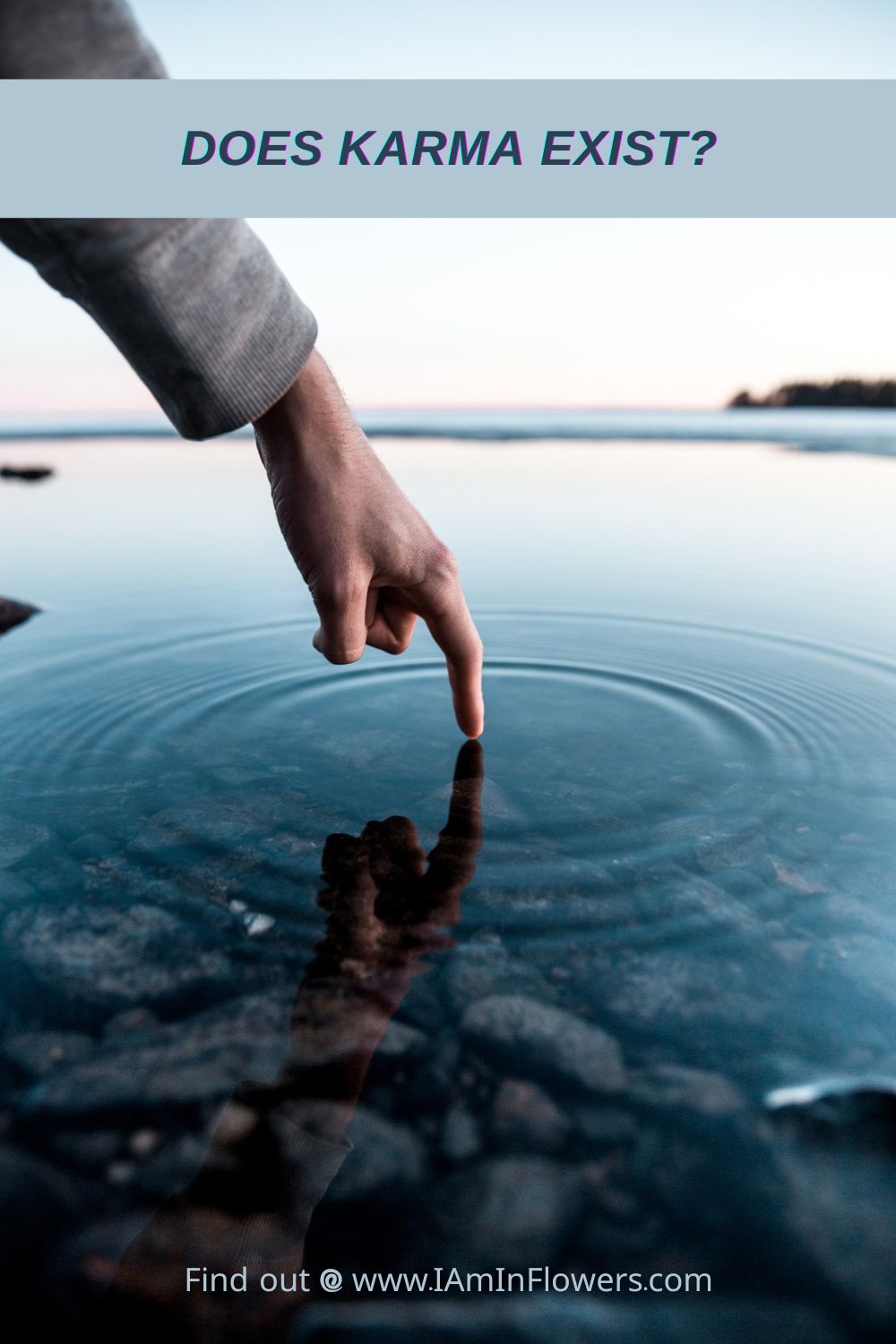
Instead, we can focus on what is real: on our intentions, on how we treat ourselves and others, on what we bring to the world. It is from this stance that true spiritual responsibility arises. Not from fear of “punishment,” but from a deep understanding that every action creates a wave that comes back to us not to punish us, but to teach us something.
And here is the essence of it all. What you think, say, and do — matters now. And this is the only karma worth paying attention to.
Overall, it might be said…
Karma, understood as a spiritual system of rewards and punishments extended over many lifetimes – does not exist.
It is not probable that something bad is “due to us” because of our past mistakes. Rather, each soul chooses its experiences with full awareness. And it’s not to pay off a debt, but to evolve, to taste life in its various colors and nuances, and sometimes even to immerse itself in limitations to see the value of this life.
There is no punishment. There is no guilt. There is only a process — alive, dynamic, full of choices. It is the soul’s desire to touch something, to learn something, to experience something. This is a completely different perspective than the one imposed by the conventional concept of karma.
If you want to talk about karma at all, it should only be in the context of the everyday consequences — what you do here and now. And this is good because it gives you back your freedom. Freedom of choice, freedom of action, freedom from the fear of a spiritual “judgment.”
And how about life? Life is not a punishment. It is an opportunity. It is a space in which you can explore yourself more deeply, more consciously, more truthfully. And how you experience your life depends not on what you did in the past, but on what you choose today.

